Google Business Profile for Therapists: A Complete Optimization Guide
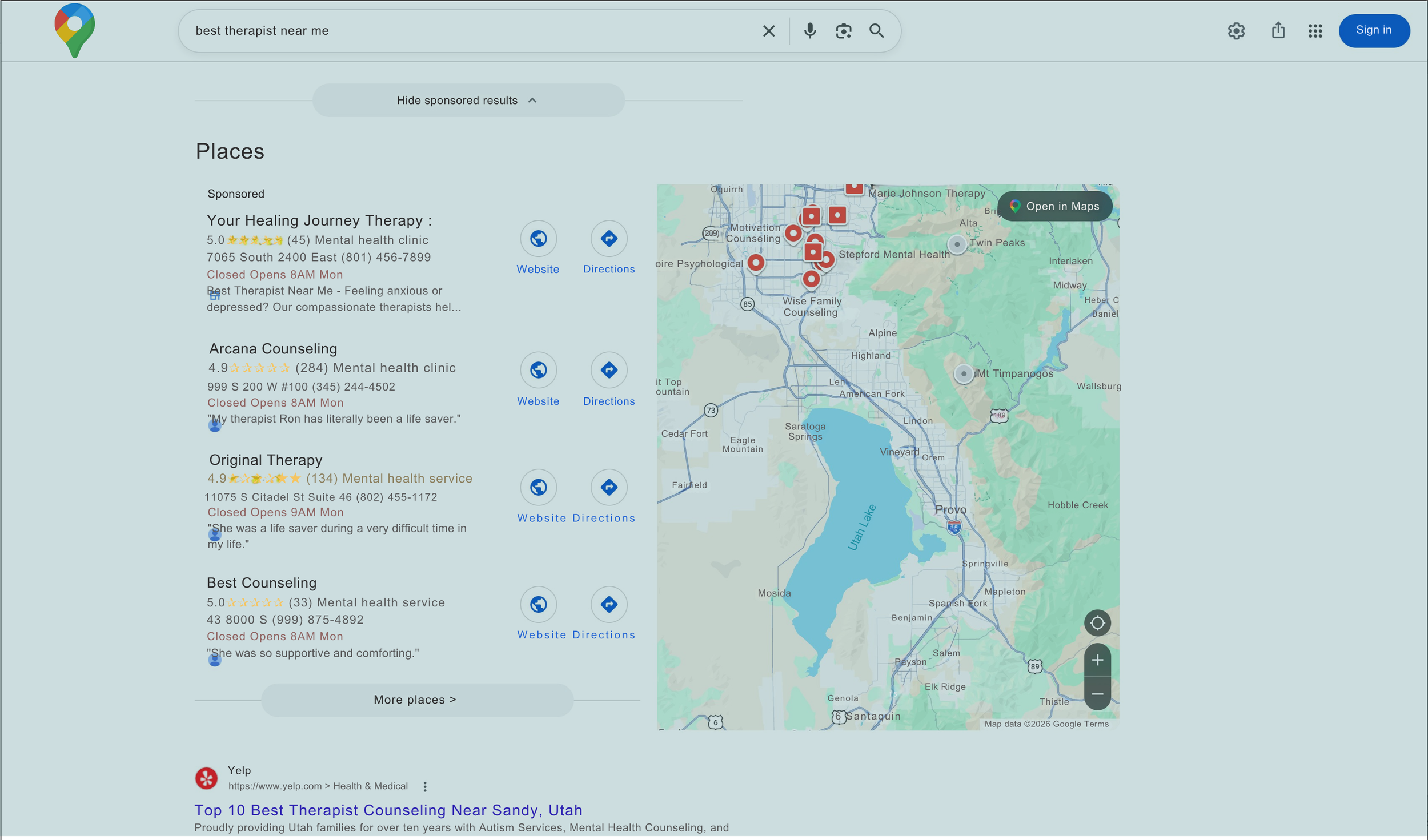
The Local Pack search results in Google
If you have been in private practice for more than a year, you’ve probably heard that you need SEO. You may have also heard that AI is replacing search. Both of those statements are partly true, yet neither one tells you what to do next. Marketing your practice should not require a second specialty. This guide gives you the information you need to optimize your Google Business Profile, show up in more local searches, and attract more right-fit clients.
Let's start with what we mean when we talk about online visibility. At its core, visibility means showing up when a potential client is searching for the kinds of services you provide — and today, that search can happen on more platforms than most people realize.
There are traditional search engines like Google and Bing. But Google now features an AI Mode that generates direct answers to search queries, as well as AI-generated summaries at the top of standard search results pages. Beyond Google, prospective clients may be searching on AI platforms like ChatGPT or Claude, looking up therapists on YouTube, or discovering providers through social media. Visibility means showing up across all of it — wherever your potential clients are asking their questions.
SEO is one of the primary ways that happens. And within SEO, there are two distinct systems that work differently, and reward different things.
General (organic) SEO is what most people picture: a potential client types "how to stop fighting with my partner" into Google, and a blog post you wrote shows up. You are reaching people who are in research mode, not necessarily ready to book.
Local SEO is something else. It governs what appears when someone searches "therapist near me" or "EMDR therapist in Denver." On Google, those searches usually produce what is called the local pack — a map with three to four business listings directly below it. These results appear above organic results for most therapy-related searches, which means local SEO is often the first thing a prospective client sees.
Your Google Business Profile is the primary tool for local SEO. It is a free listing that Google maintains separately from your website, and it is what determines whether your practice appears in that map section. A well-optimized profile can generate consultation calls. A neglected one is functionally invisible.
A Note on the Research Behind This Guide
Local SEO is a field with its own research community. This article leans on the work of three local SEO firms that publish rigorous studies on what drives local rankings: Whitespark, Sterling Sky, and BrightLocal. These are not casual bloggers. They run controlled experiments, analyze ranking patterns across thousands of listings, and publish findings that the broader SEO industry relies on.
When this guide attributes a claim to one of these agencies, it reflects empirical testing — not opinion. Where research has not settled a question, that is noted as well.
Before You Optimize: Verify Your Profile
Everything in this guide assumes your profile is verified. If it is not, start there first — verification is more involved than most people expect, and Google will not display an unverified profile in map results.
BrightLocal maintains a thorough, current guide to the verification process: How to Verify Your Business on Google. Google has introduced several new verification methods in recent years, including video verification, and the process varies by account history and business type. Set aside some time for it.
First: Understand What Google Business Profile Controls
Your Google Business Profile controls your presence in the local pack — the map-based results that appear in Google Search and Google Maps. This is a separate ranking system from your website's organic search performance.
There are two reasons this is important. First, doing GBP work well can get you visible in the local pack even if your website has not yet built significant organic authority. Second, your website still functions as a trust signal for your profile. The two systems reinforce each other, and neither substitutes for the other.
Step 1: Get Your Primary Category Right
Your primary category is the most important field on your entire profile. According to Whitespark's 2026 Local Search Ranking Factors survey, it is the single strongest ranking signal in the local pack.
Google uses your primary category to determine which searches your profile is eligible to appear in. If the category is wrong or too broad, you will not show up for the searches that matter — regardless of how well you have optimized everything else.
The principle is simple: choose the category that most closely matches the primary service you most want to rank for. Among the most relevant options for therapists:¹
Psychotherapist — accurate and competitive for general individual therapy practices
Mental Health Counselor — appropriate for LPCs and similarly licensed clinicians
Clinical Social Worker — a good fit when that credential is primary
Counselor — broad, lower-specificity option
Marriage or Relationship Counselor — best for practices with a primary focus on couples work
Family Counselor
Psychologist — only if you hold a masters or doctorate in psychology
Mental Health Service or Mental Health Clinic — better suited to group practices than solo clinicians
A complete list of relevant GBP categories appears at the end of this post. Please note that this list is updated frequently, without notice from Google.
Step 2: Add Relevant Additional Categories
Google allows up to nine additional categories beyond your primary. Each one tells Google to consider your profile for additional search terms, and each one unlocks a set of pre-defined services you can add to your profile (covered in Step 4).
For a solo therapy practice, Sterling Sky research suggests staying within four to six total categories. More than that can diffuse your topical relevance rather than expand it. For group practices with genuinely broad service offerings, five to eight is a reasonable ceiling.
Check your available categories every six months. Google updates them without notice.
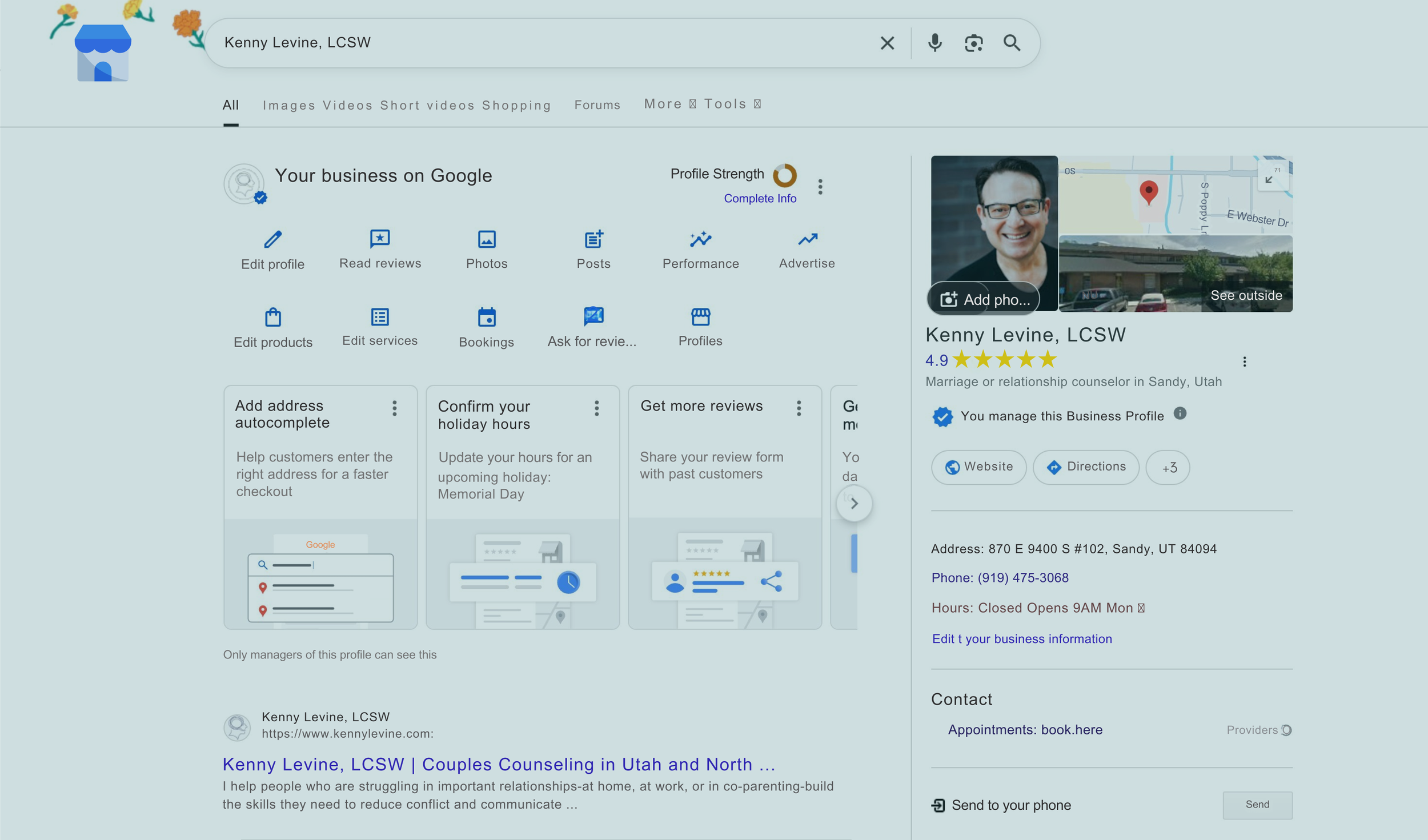
The Google Business Profile dashboard — where your local search visibility is built and managed.
Step 3: Complete Every Section of Your Profile
Once verified, the rule is straightforward: complete every available field. Incomplete profiles rank poorly, and Google extends visibility to businesses it has reason to consider legitimate and active.
The fields that matter:
Services (covered in Step 4)
Business description (covered in Step 5)
Hours of operation – make sure these EXACTLY match copy on your website
Website link – usually your homepage, though if you are a multi-location practice this may be that profile’s location page
Photos (covered in Step 6)
Appointment link (covered in Step 7)
Phone number – it’s helpful to have a local phone number
Service areas
Posts (covered in Step 9)
Step 4: Use the Services Section — The Most Underused Ranking Lever
Most therapists skip this section entirely. That is a meaningful missed opportunity.
In 2022, Sterling Sky published research demonstrating that adding services to a Google Business Profile produces measurable ranking improvements, in some cases within 24 to 72 hours. Whitespark has since confirmed the effect in their own testing.
The mechanism works in two ways:
Pre-defined services are the options Google suggests based on your categories. These carry the most ranking weight and should be added first. To find them, go to your GBP dashboard, click "Edit Services," and look for "Add more services" under each of your categories. Select every option that accurately describes what you offer.
Custom services are services you define yourself. Research suggests they carry ranking value as well, particularly for lower-competition, long-tail keyword queries.
Adding services also triggers what is called a "Provides" justification in search results — a line beneath your listing that reads "Provides: EMDR Therapy" or "Provides: Somatic Therapy." This makes your listing visually distinct and confirms relevance to the searcher before they ever visit your website.
For therapists, relevant services to consider include:
EMDR Therapy
Internal Family Systems (IFS) Therapy
Emotionally Focused Therapy (EFT)
Somatic Therapy
Trauma Therapy
Anxiety Therapy
Depression Counseling
Grief Counseling
Online Therapy / Telehealth
Child and Adolescent Therapy
Do not simply add service names — write a description for each one. Most competitors will not bother. A concise, specific description of what you offer and who it is for turns a plain service listing into a conversion asset.
Example: EMDR Therapy — "Eye Movement Desensitization and Reprocessing (EMDR) for adults working through trauma, PTSD, and anxiety. Available in-person and via telehealth."
One maintenance note: Google sometimes auto-adds services to your profile without notification. Audit your services list quarterly to remove anything inaccurate and add anything new.
Step 5: Write a Business Description That Attracts Right-Fit Clients
The business description field has a 750-character limit. It appears in your Knowledge Panel in Google Search and in Google Maps.
Here is something that often goes without mention: the description does not directly impact your local rankings. Keywords in your description will not move you up the map. This has been tested and confirmed repeatedly by the leading local SEO researchers.
What the description does is convert. It is the first substantive thing a searcher reads after your name and star rating. Write it for the person deciding whether to contact you — not for an algorithm.
A strong description includes:
Your name and primary service in the first sentence
Your location and service delivery format — telehealth, in-person, or both
Your most relevant credential or clinical training
The populations or presenting concerns you specialize in
Geographic areas you serve
Example: Somatic therapy and trauma-focused individual counseling in Denver and throughout Colorado via telehealth. Specializing in complex trauma, anxiety, and nervous system regulation using Somatic Experiencing and EMDR.
One practical threshold: Google truncates descriptions before the reader clicks to expand. Everything that matters — your name, primary service, location, and key credential — should appear in the first 250 characters.
For practices licensed in more than one state: write a distinct description for each GBP location. Do not copy and paste the same text. Google's guidance for multi-location businesses is to reflect each specific area in the corresponding profile.
Step 6: Approach Photos More Strategically Than You Probably Have
Google's own data indicates that businesses with photos receive significantly more requests for directions and website clicks than those without. But there is a ranking dimension most practitioners do not know about.
Google uses Vision AI to classify and analyze the images on your profile. The AI reads what is in each photo and uses that to reinforce its understanding of what your business does. A photo that Google classifies as a professional office or a clinical space strengthens your category signals in ways that a generic image does not.
Essential photos for every therapy GBP:
Interior office shot — your actual space, not a staged generic room
Professional headshot — prospective clients want to see who they are contacting
Building exterior — confirms the location is real and helps clients find you
Avoid stock photos. Research by Near Media found that replacing stock images with original, authentic photos correlates with measurable increases in profile engagement. Google's Vision AI also classifies stock images differently from original content.
Add new photos every one to two months. Consistency signals an active, legitimate practice.
A note for multi-location practices: photos carry GPS metadata from where they were taken. Upload photos from each location to the correct GBP profile. A photo taken at one office uploaded to a different location's profile sends conflicting geographic signals.
Step 7: Use the Appointment Link — and Send It to the Right Page
Most therapy categories do not qualify for Google's full booking integration — that feature is reserved for dining, beauty, fitness, and a few other verticals. But the appointments link is available to therapists and worth configuring.
The appointments link directs searchers to a specific page on your website. It appears as a button on your profile. The question is which page to send them to.
Send them to your primary service page — the page that most directly corresponds to what a prospective client found you searching for. For a couples-focused practice, that is your couples counseling page. For a trauma-focused practice, your trauma therapy page. Do not send them to your homepage. Homepages are orientation pages, not conversion pages. A searcher who has already found you via a local search for "EMDR therapist" does not need to learn who you are from the beginning — they need a clear path to contact you.
You could also consider linking directly to your appointment booking system through your EHR — SimplePractice, TherapyNotes, and similar platforms all generate a bookable client-facing URL. The case for this is straightforward: it is the shortest path between "I found you on Google" and "I have a consultation scheduled." Zero extra clicks, no reading required.
The tradeoff is that a prospective client who finds you through a local search has not necessarily made a decision yet. They are evaluating. Landing them directly on a booking calendar — before they have read anything about your approach, your fees, or what to expect — can produce drop-off or inquiries from people who were not a good fit. A service page gives them the context they need to self-select before they book.
Neither option is wrong. What matters is that the link goes somewhere specific and deliberate — a booking page or a primary service page — rather than your homepage. Homepages are orientation pages, not conversion pages, and a searcher who already found you for a specific reason does not need to start from the beginning.
Step 8: Audit Your Attributes
Attributes are the descriptive tags on your profile: "Online appointments," "Telehealth," "LGBTQ+ friendly," "Accepts new patients," and similar designations.
Attributes do not influence rankings for broad searches. They do influence rankings when a searcher includes the attribute in their query. Someone searching "LGBTQ+ friendly therapist Salt Lake City" will see profiles that have the corresponding attribute enabled.
Navigate to Edit Profile, then "More," to see what is available for your categories. Apply everything that accurately describes your practice. Google updates available attributes periodically, so review this section at least twice a year.
Step 9: Use Google Posts as Free Advertising Real Estate
Google Posts — now called Updates in the interface — are short pieces of content that appear on your profile in Search and Maps. Current research indicates they do not directly impact local rankings. What they do is function as free conversion space in front of people who are already evaluating whether to contact you.
That distinction should shape how you write them. A person visiting your GBP is not browsing — they are deciding. Write accordingly.
Example: Now accepting new clients for trauma therapy and EMDR in Portland, OR — telehealth available throughout Oregon. Click below to schedule a consultation.
Post once a week. Each post can include a photo, up to 1,500 characters of text, and a call-to-action button. Only the first 16 to 20 words appear before the reader clicks to expand, so lead with what matters most.
Useful post formats for therapists:
Announcing availability for a specific service or geographic market
Highlighting a credential, training, or media feature
A direct description of a service with a "Learn more" or "Book now" call to action
A professional achievement or organizational affiliation
Step 10: Reviews — The Ethical Reality for Therapists
Reviews are among the most powerful ranking and conversion factors in local search. According to BrightLocal's Local Consumer Review Survey, healthcare consistently ranks among the industries where consumers consider reviews most important to their decision-making — and the top industries where prospective clients read reviews most carefully are healthcare, service businesses, and automotive services, in that order.
Here is the challenge: therapists are ethically prohibited from soliciting reviews from current clients. This is not a technicality. It is an ethical boundary grounded in the power differential inherent in the therapeutic relationship and in clinicians' confidentiality obligations. The ethics guidelines of the National Association of Social Workers (Section 4.07), the American Counseling Association (Section C.3.b), and the American Psychological Association (Section 5.05) all address this.
These ethics guidelines apply across every context, from your verbal interactions with clients to the way you set up your office space. A QR code or sign in your waiting room asking for reviews is an ethics violation. Your waiting room is a clinical space, and it exists for your clients’ comfort. A link on your website asking for reviews is a bit of a gray area, as your website serves a broader audience than your current caseload.
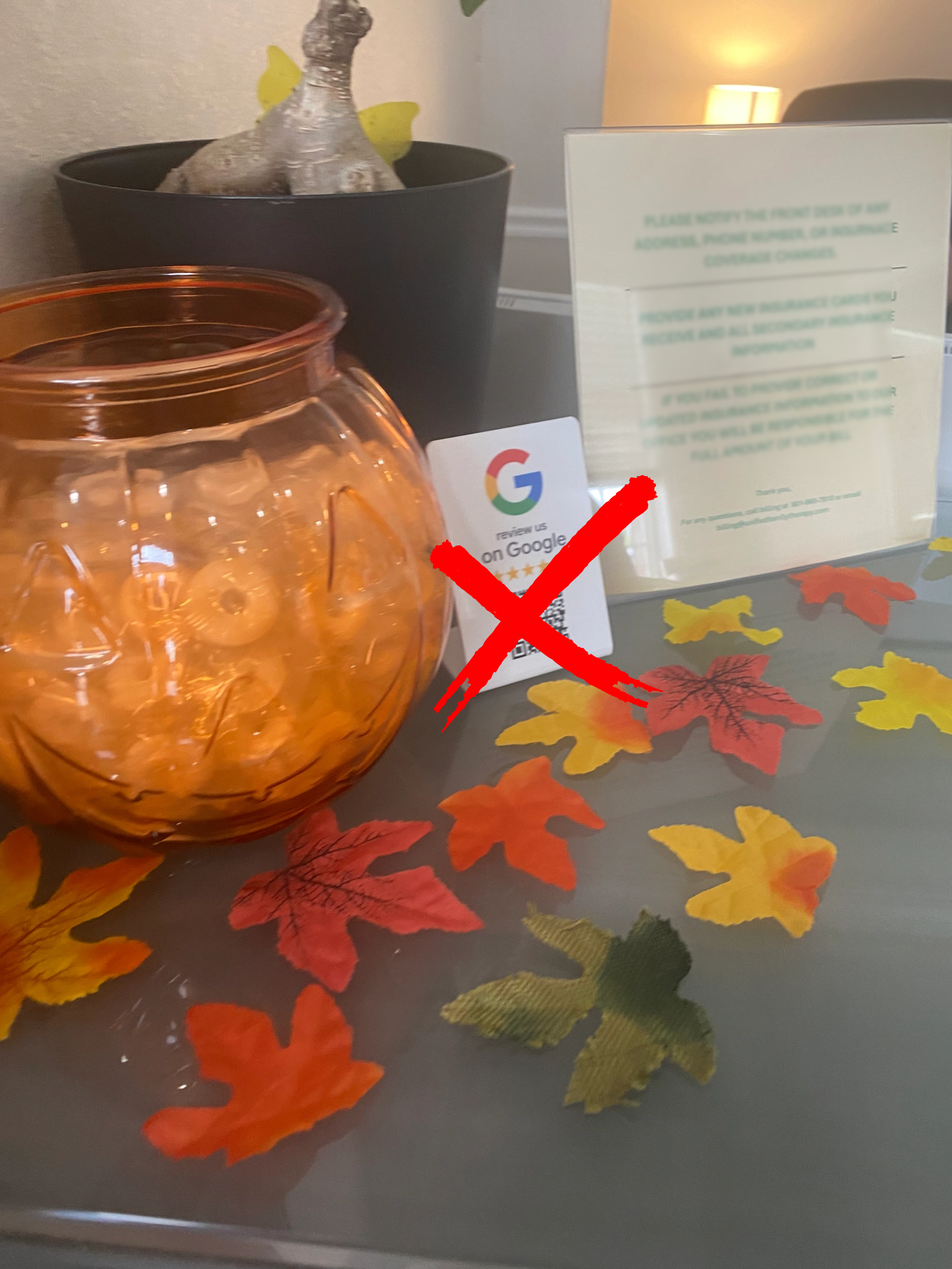
This is one of the most common ethics mistakes therapists make.
Your waiting room is a clinical environment, and the people sitting in it are your clients. They came to you for help. Asking them for a review puts your marketing interests above their care.
What You Can Do
You can ask colleagues, referral partners, professional contacts, and others who know your work outside of a therapeutic relationship. This includes other clinicians and allied health professionals you have worked with directly, supervisors, peer consultation group members, and people in your broader professional community.
Asking former clients for reviews is not explicitly prohibited by most ethics codes. That said, I recommend against it. The therapeutic relationship carries weight that doesn't simply end at termination — and if a former client ever wanted to return to treatment, a prior review request could complicate that. It may also put the client in an awkward position, even if unintentionally. The fact that something isn't prohibited doesn't make it a good idea.
When you reach out, be specific about what you would like them to address. A review that mentions a particular modality or clinical population is more useful than a generic endorsement — both for search visibility and for conversion.
Respond to reviews from colleagues and professional contacts, but exercise real caution with any review that may have come from a current or former client. Responding to a client review risks a HIPAA violation — and that applies to positive reviews as much as negative ones. The instinct to thank someone for kind words is understandable. The instinct to defend yourself against a critical review is even stronger. Neither is worth acting on. Responding to a negative client review with a carefully worded disclaimer about not confirming the therapeutic relationship is not a safeguard — it is a signal that you have already come too close to the line. Marketing matters, but it is never worth an ethics violation, or even the appearance of one. If you have any reason to believe a reviewer was a client, do not respond.
Rate of Reviews and Practical Cautions
Aim for roughly one new review per month rather than accumulating many at once. Google values sustained velocity — consistent reviews over time carry more weight than several reviews in a single week followed by months of silence.
Do not have someone write a review while sitting in your office on your WiFi network
Do not have multiple reviews submitted from the same device or IP address pattern
Do not engage in review exchanges with colleagues — this is a violation of Google’s guidelines. Reciprocal reviews posted close together from the same geographic area are frequently removed
Google detects suspicious review patterns and removes reviews regularly. Gradual, organic growth is both more durable and more defensible.
A Word on Negative Reviews
If you receive a one, two, or three-star review, do not panic. A handful of imperfect reviews does not hurt you — in fact, an all-five-star profile can work against you. Both Google and prospective clients treat a perfect rating with some skepticism. A 4.6 or 4.8 with a meaningful number of reviews reads as more credible than a 5.0 with five reviews.
If you receive a negative review and you have reason to believe it came from a client, take the advice above and do not respond. If it came from someone outside a therapeutic relationship, you can respond briefly and professionally, but in most cases the better move is simply to let it go. The most effective way to handle a bad review is to earn new ones. A steady cadence of positive reviews from colleagues and professional contacts will push it down over time, and that is where your energy is better spent.
Step 11: Multi-State Telehealth Practices
Telehealth has made multi-state practice increasingly common. As licensing portability has expanded, more therapists maintain an active client base in two or more states — sometimes with a physical office in each, sometimes not.
If you have a physical office in two or more states, you are eligible for — and should have — a GBP in each. Google requires a physical address to create a standard business listing. If you practice exclusively via telehealth without a physical office in a given state, you are not eligible for a standard GBP there; you would need a service area business profile instead, which does not display an address and performs more modestly in local rankings.
For practices with offices in two or more locations: keep the profiles genuinely distinct. Use different descriptions written for each market, photos taken at each location, different service area language, and different post content. Google's own guidance for multi-location businesses is explicit — each profile should reflect its specific location.
Maintain NAP consistency within each market. Your name, address, and phone number should be identical across your GBP and every directory citation for that location. Inconsistencies create conflicting signals and suppress local rankings.
NAP Consistency
NAP stands for Name, Address, and Phone Number — the three pieces of identifying information that Google cross-references across your website, your GBP, and every directory listing that mentions your practice. When those three elements are identical everywhere they appear, Google has high confidence that it is looking at the same business. When they are inconsistent — a suite number that appears on some listings but not others, a phone number that changed two years ago and never got updated everywhere, a business name that appears slightly differently across platforms — Google treats those as conflicting signals, and local rankings suffer.
For therapists, common sources of inconsistency include Psychology Today, Therapy Den, TherapistFinder, Yelp, Healthgrades, and any state or specialty directories where your practice is listed. Run a citation audit periodically to confirm that your name, address, and phone number are identical across all of them — not close, not close enough, identical. If you have moved offices, changed your phone number, or updated your business name at any point, that audit is overdue.
Step 12: Make Sure Your Website Reinforces Your GBP
Your website and your GBP operate as a system. The profile signals to Google what you do and where; your website signals that the claim is credible.
Start with the basics: your name, address, phone number, and hours should be identical on both. Hours are worth specific attention. Google Business Profile lists your hours by day — Monday through Sunday, each one separately. Your website should do the same. "Monday through Friday, 9am to 5pm" in a paragraph of copy is not the same thing. List each day individually, exactly as they appear on your GBP. Inconsistencies between your website and your profile create conflicting signals that suppress local rankings.
Beyond that, your site should clearly communicate your services, locations, specialties, credentials, and contact information. Dedicated service pages and location-specific pages carry meaningful weight. The more directly your website confirms what your GBP claims about your practice, the more confidence Google has in surfacing your profile for relevant local searches.
Step 13: Build Local Authority Beyond the Profile Itself
Your Google Business Profile does not exist in isolation. Google also evaluates your website, backlinks, directory citations, and mentions across the web when determining where you appear in local results.
Strong local signals for therapists include:
Mentions or features in local news publications
Podcast appearances with local or regional outlets
Chamber of commerce listings
Listings in local and specialty therapist directories
Speaking engagements and community events
Backlinks from locally relevant websites
Geographic authority accumulates slowly and compounds over time. A mention in a publication based in the city you serve is worth more to your local rankings than a generic directory link, because it signals genuine connection to the community you claim to serve.
Step 14: Maintain What You Have Built
GBP optimization is not a one-time project. Google changes available categories, attributes, and pre-defined services without notice. Competitors can suggest edits to your profile. Users can post photos and Q&A responses you have not reviewed.
Set a quarterly reminder to:
Audit your services list for auto-added or removed items
Check for new categories or attributes relevant to your practice
Review the photos section for any customer-uploaded images
Confirm your name, address, phone number, and website link are still accurate
Fifteen minutes every three months protects the work you have invested. The practices that sustain strong local rankings over time treat this as routine maintenance, not a one-time project.
The Bottom Line
Google Business Profile is the most underutilized free marketing asset available to independent therapists. The local pack appears above organic results for most therapy-related searches, and you do not need an advertising budget to show up there — you need a complete, accurate, well-maintained profile.
The fields that move local rankings: primary category, additional categories, services, and website. The fields that convert but do not rank: description, photos, posts, Q&A, and attributes. Know the difference, invest accordingly, and revisit your profile every quarter.
If you are managing a multi-state practice, confirm that you have a physical address in each state before creating a second GBP. Then treat each profile as its own asset — distinct content, distinct photos, distinct local signals.
A well-optimized GBP gets you found. A well-built website converts that visibility into consultations. Clinique Digital Consulting helps therapists and group practices build the kind of online presence that consistently attracts right-fit clients.
Your work deserves to be visible. Let’s make that happen.
¹ Complete List of GBP Categories Relevant to Therapists
The following is a comprehensive reference of Google Business Profile categories relevant to mental health and therapy practices, compiled from the Sterling Sky category database and Cedar Web Agency healthcare category lists.
Core Therapy and Counseling
• Psychotherapist
• Psychologist
• Counselor
• Marriage or Relationship Counselor
• Family Counselor
• Child Psychologist
• Child Psychiatrist
• Psychiatrist
• Psychoanalyst
• Mental Health Clinic
• Mental Health Service
• Mental Health Counselor
• Licensed Professional Counselor
• Social Worker
• Clinical Social Worker
• Behavioral Health Service
• Addiction Treatment Center
• Eating Disorder Treatment Center
• Rehabilitation Center
Specialized and Behavioral Categories
• Biofeedback Therapist
• Hypnotherapy Service
• Mediation Service (only if providing mediation)
• Career Guidance Service
Group Practice and Broader Behavioral Health
• Counseling Center
• Community Health Centre
• Wellness Center
• Holistic Medicine Practitioner (for integrative practices)
Autism, Developmental, and Child-Focused
• Autism Service
• Developmental Center
• Educational Psychologist
A note on findings from Sterling Sky
Their research specifically supports using multiple category slots strategically — but recommends staying within four to six categories for solo practices and five to eight for group practices. More categories beyond genuine relevance can dilute rather than expand your topical authority.
Research sources: Whitespark 2026 Local Search Ranking Factors Survey; Sterling Sky GBP Services Research (2022); BrightLocal Local Consumer Review Survey; Near Media GBP Photo Research.